The top 10 “most wanted” UN organisations on the UN Job List

With the introduction of the interest indicators for jobs a few weeks ago, not only applicants have the ability to see what kind of interest there is for a job, but also I can now see which UN organisations are the “most wanted”.

I did a quick and dirty calculation and these are the top 10 organisations and number of views on all their active vacancies on the UN Job List over the past days:

  1. UNDP – 2561 views
  2. UNICEF – 2309 views
  3. UNOPS – 1661 views
  4. WHO – 1257 views
  5. FAO – 1110 views
  6. UNEP – 734 views
  7. IFC – 729 views
  8. IMF – 713 views
  9. UNON – 570 views
  10. World Bank – 539 views

Of course these are just very initial figures. I will work on getting them down to a “views per day per vacancy” figure to eliminate influences like duration of posting (which is very short for UNDP and thus means fewer views), number of vacancies (where UNDP gains views) so that you have a good indicators which organisation’s UN jobs are most wanted.

If you have ideas for analysis you would like to see, please leave them in the comments below – thanks!

Visualizing the Long Tail of UN Job List vacancies

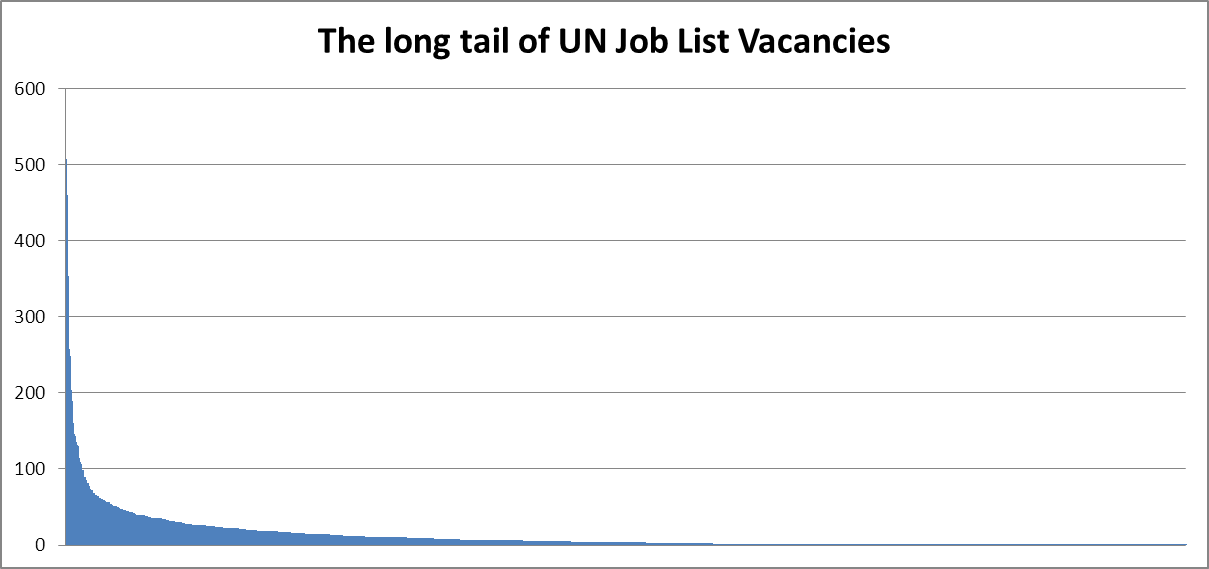
Earlier today I was mentioning in a tweet that there seems to be a long tail (also see here: http://en.wikipedia.org/wiki/Long_Tail ) for UN Job List vacancies. To illustrate what I mean, have a look at the graph below. The chart shows external views of vacancies listed on the UN Job List over the past 7 days. There are a few vacancies on the very left side that are excessively high in demand. And then interest seems to fall off pretty quickly.

My take: try to find vacancies that don’t show too much interest and still fit your interest. Don’t just apply because there seems to be “low” competition but be realistic about what are the odds of being “the one” of the many thousand applicants…

UN Job List Twitter Accounts

The UN Job List exists since I believe that great people make the UN System great. And I wanted to make it as easy for great people to find their spot in the UN System as possible. So to achieve that, I added not only offer bookmarking friendly search results pages, custom RSS or e-mail alerts but also to offer the job updates via Twitter.

@UNJobList has been pumping out jobs via Twitter for a while and to take care of different tweet formatting, I added @UNJobList_DL and @UNJobList_DS at a later point, too. Whenever I found interesting resources to share, or implemented any new thing on the UN Job List, I threw these news into the existing streams.

However, there are people out there who are not interested in the jobs directly but want to get the updates and others who just want to get the jobs and not the updates. Also, there are a lot of jobs and so there is a flood of job tweets which makes it hard to follow the news tweets. It was time to do something about this setup and so as of today there will be a new account @UNJobList_news which is dedicated to conversations with UN Job List users and the occasional news announcement.

In a nutshell this is what the setup looks like:

  • @UNJobList_news: Conversations, news, announcements, questions interesting links.
  • All jobs land on Twitter as soon as they are discovered by the UN Job List
  1. @UNJobList: Tweets carry Post Title & Job Level
  2. @UNJobList_DL: Tweets carry Post Title & Application Deadline
  3. @UNJobList_DS: Tweets carry Post Title & Duty Station

Note: All three job feeds carry the same content, the only difference is the formatting so no need to follow more than one.

I personally recommend you following the @UNJobList_news and any of the other feeds according to your taste to get the full coverage. But make sure you follow @UNJobList_news to stay up to date with what is happening on the UN Job List.

Talk to you soon,
Sebastian

PS: Just to make things perfectly clear: Everything I say on Twitter (and on Facebook and also here on my blog) is my own. I don’t speak for neither my employer nor for anyone else.

Update from “the List”: Interest indicator for vacancies beta test

One of the most frequent questions I receive from job hunters is about the competitiveness of different vacancies. Applying to a job is very time consuming if done properly and of course we all want to know what we are up against when applying to a job.

Since I have no insight into the data of the actual agencies I obviously can’t answer the question on how many people applied. Also, if we assume that most people apply shortly before the deadline, the number of applications as information would be too late to be of any real value. However, what I can do to gauge interest is to measure the number of click-throughs to the actual vacancy. What I mean by that is the number of times people decide to leave the UN Job List and view the vacancy on the organization’s homepage.

I have now implemented this view counter and shown the data for this counter on the UN Job List’s vacancy detail page. You will see two graphs on any vacancy detail page: One listing the views per day over the past 5 days:

Views per dayPlease note: The graph is capped at 20 views per day.

And another graph that shows how this vacancy relates to other vacancies on the UN Job List:

Interest in the vacancy

The graph displays the overall average views per day in relation to the average views of all UN Job List listed jobs. This graph is also updated daily and since there is always a higher initial interest in any new job especially after the job has been twittered, this graph is biased towards the “high interest” spectrum right after it has been discovered by the UN Job List.

Please let me know what you think of these statistics and graphs in the comments below – thank you!

Mine Action Day

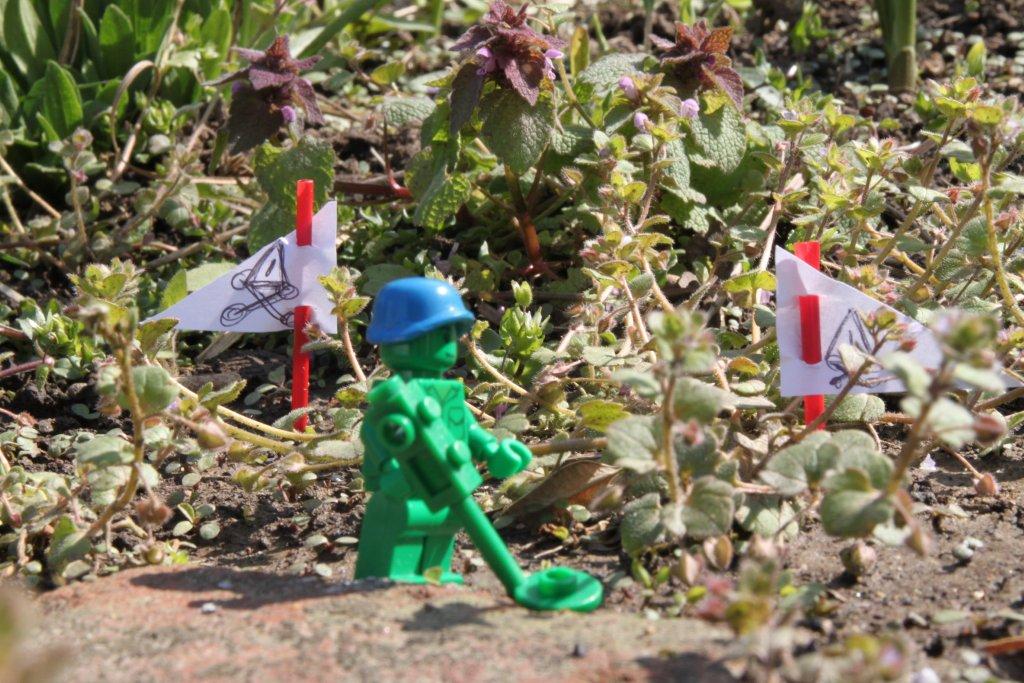
Today on April 4th is International Day for Mine Awareness and Assistance in Mine Action 2011. On the picture you can see the Little Peacekeeper working with his tool in this very dangerous job. He salutes the UN colleagues who help clear mines all over the world and reminds us to not leave the victims of mines behind. To learn more about this important work, visit http://mineaction.org

Santa Tereza

This picture of the Little Peacekeeper is taken in Santa Tereza with a favela in the background. The Little Peacekeeper is curious to learn all about the UPP (Unidades de Polícia Pacificadora, Pacifying Police Units) an innovative policing approach which is applied in this area and which is aiming address the numerous security challenges for favela community and improve the local conditions. If you would like to know some more about the UPP have a look here: http://www.wilsoncenter.org/index.cfm?fuseaction=events.event_summary&event_id=655855